
Building Capacity: The First Hedge Against the Mindless Busy Frenzy
A Few Questions to Ask If You're Constantly Responding to Demands

Everything you know about a more fulfilling life is useless without capacity.
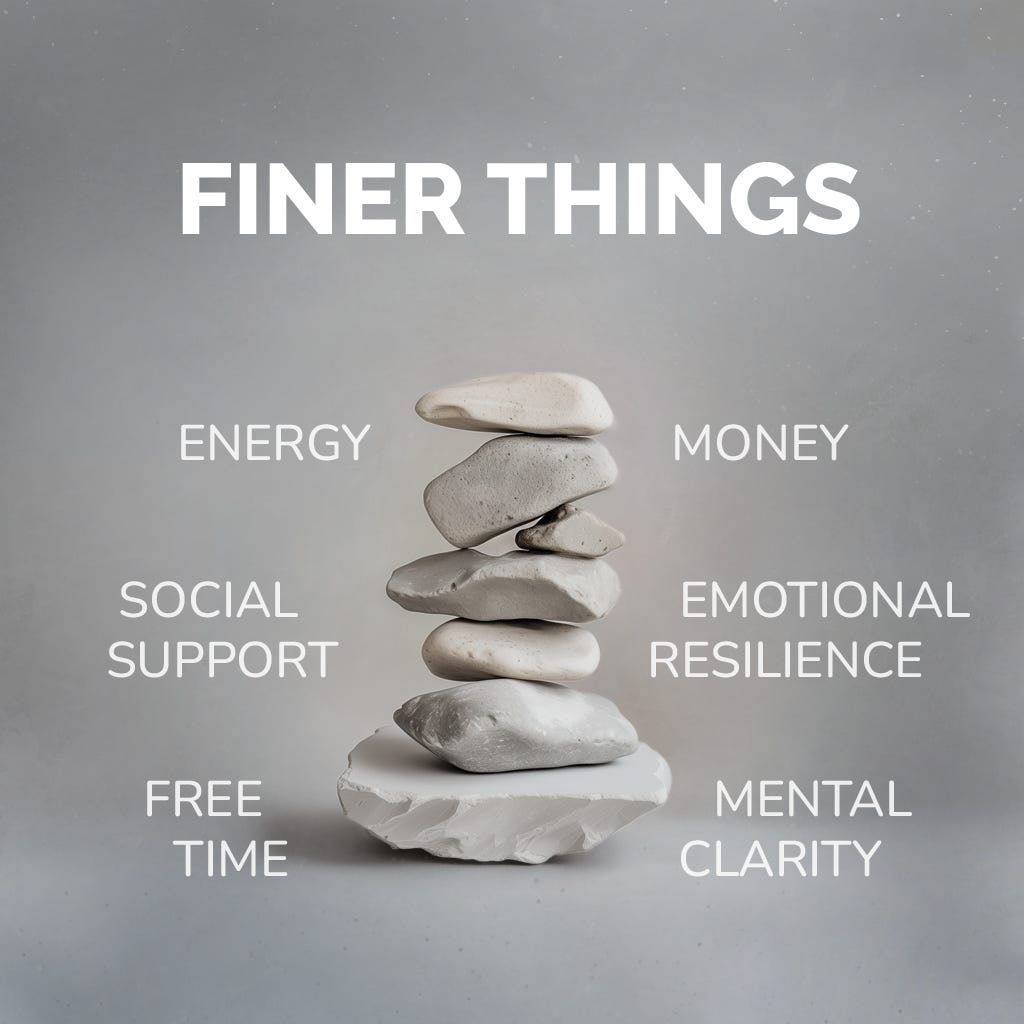
Let’s define capacity as free time, energy, money, social support, emotional resilience, and mental clarity.
If demands outweigh capacity, there's no room to grow.
No room to breathe. No room for anything more. All attempts to aim at higher things fall flat.
How often have you tried to add good habits to your life? Become a better version of yourself? Bring back the carefree joy you felt as a child?
How many times have those attempts left you more drained?
I'm intimately familiar with the downward spiral when everything hits capacity, with no margin or reserves.
Bad sleep, nothing to wear, parking fines, lost keys, broken-down cars, empty toilet rolls, rush-hour traffic, skipped meals, maxed-out phone storage, piled-up dishes, overloaded inboxes, missed birthdays, and forgotten appointments.
One workaround stacked on top of another, rushing more and more, until suddenly all I could think of was punching the letterbox.
No wonder we get annoyed at the car in front of us, our partner who doesn’t do the dishes, our boss who doesn’t provide direction, or anything else slightly irritating.
And so we crave the next holiday, the next escape from the uninspired everyday grind.
As we go through life, we sometimes stumble across happiness: a new relationship, an epic adventure, or unexpected success. Everyday Strategy isn’t about those things because they are elusive.
I’m more interested in what gets you out of bed on a Monday morning. What keeps you going on a Wednesday afternoon.
But for mundane moments to be fulfilling, we need a reality check. We need to get into the weeds.
There's a huge disconnect between the idealistic life fantasies we see on social media and the unsexy realities of everyday life.
The majority of today’s parents spend more time on childcare than ever before1, more time in the workforce, bombarded with more advertising, distractions, and comparisons than at any other time in history.
The burnout epidemic2 doesn’t just affect parents. Post lockdowns, working from home increased the average workday by nearly an hour3.
We all have a list of obvious things we’re told to do in order to cope a bit better:
Eat better
Sleep more
Exercise
Meditate
Love yourself
Be present
Live your dreams
And my personal favourite: ‘Just calm down’
Not bad advise, but even these seemingly practical things are five steps removed from the reality of so many of us. They assume a level of stability many people don’t have. If you’re already overwhelmed, additional goals just add to the exhaustion.
How do you eat better if you barely have time for the drive-thru?
How do you sleep more or meditate if racing thoughts keep you up, and you can’t afford therapy?
How do you exercise more if you’re constantly ill?
And how do you live a Zen lifestyle when all you want to do is punch the overflowing rubbish bin?
One does not simply go from burnout-busy to calm by reading some inspirational quote like 'live in the moment'.
Popular self-help advice would have you believe that if you just do the things we all know to do, and throw in a few positive affirmations, life will sort itself out.
There is no mention of all the little things that prevent us from doing the obvious. While dismissing the messy and complex issues, there is more talk about 'being present' and 'loving yourself.'
It sounds so simple, like a quick fix, but these are complex things to master. They're like the cherry on top of the self-actualisation cupcake.
People like to talk about cherries, not flour-and-butter stuff. But the flour-and-butter stuff is where we get fed and confidence is being built, even if it sounds dumb or boring.
We don’t get stronger by running on a broken leg. I don’t care how unsexy it is - mundane, boring things are where real growth starts.
We need strategies, not wishful thinking. Realistic strategies that embrace the messiness of life.
First, we get out of survival mode - then we do better.
Here’s where I’d start. Let me know what you think.
2-Hour Capacity Challenge
Can you free up two hours a week?
Let’s find out.
Read the prompts below and see if anything resonates. Maybe there’s a gap between where you are and where you could be - and if so, is it big enough to give you two hours that are unconditional, where you are free from the immediate demands of your environment, free from the frenzy?
Think of the past week - was there a time when you got stressed or overwhelmed? What happened right before? Can you defuse that trigger?
Of all the things you’re doing, is there something you perceive as wasted time? Realistically, do you have the energy and mental clarity to use that exact time for something more meaningful?
At what time of day do you naturally have the most energy, and what kind of activity usually fills this time? Challenging and important tasks?
What low-key annoyances are bugging you daily but seem too small to tackle? Is there a fix worth the effort?
Of all the tasks on your to-do list, is there one with a multiplier effect - one that will make things easier in the future and free up more resources than you have to put in?
What’s most scarce in your life right now - money, social support, energy, or free time? Do you have untapped reserves in any other areas that could be poured into what’s needed most?
How often and how easily do you feel guilt or shame? And are they actually keeping you ‘in check’ or draining energy that could be used for something more fruitful?
Can you realistically stay on top of everything without saying ‘no’ to something that matters?
Is there something within your control that you know would make your life better, but you just can’t do it? Break it down into basic steps, so simple it seems ridiculous.
Are there things you’re doing for others that, somehow, benefit neither you nor them?
Do you actually want more ‘free’ time? What does ‘doing nothing’ feel like? Would you allow yourself not to be productive?
Pick one and act. Start freeing your life from the chaos, no matter how small the first step seems.
And if you succeed in building capacity, what will you use it for?
To be more productive, again? To play? Or just to be?
The point of this exercise isn’t to go from busy to Zen in a week. The point is to stop revving the engine with wheels spinning out, to put a rock under the muddy tyres and feel them grip.
With realistic expectations, you regain traction and control.
If you haven’t had white space in a long time, I recommend using your first two hours to reflect.
It’s rare to stop and think about where we’re headed without external circumstances forcing us. Don’t wait for burnout or some other crisis to question your reality.
Use this time to get strategic about your way forward.
Build many hedges against mindless busyness, and one day, you’ll have the capacity to create a vision and reach for something higher than base responsibilities.
Studies show that today’s parents, especially mothers, spend significantly more time on childcare than previous generations, despite being more likely to work full-time. A report from the Pew Research Center found that modern mothers spend an average of 14 hours per week on childcare, compared to 10 hours in 1965, and fathers have tripled their time spent on childcare. Alongside this, parents face an unprecedented level of digital distractions, advertising, and societal comparisons due to the rise of social media and digital marketing, further intensifying daily pressures.
Burnout, while often associated with parents balancing work and home responsibilities, affects a broader spectrum of people, especially in the post-pandemic work environment. According to The Burnout Epidemic by Jennifer Moss, burnout has escalated across various professions, exacerbated by increased workloads and the complexity of remote work.
According to a Harvard Business School survey, working from home during and after lockdowns extended the average workday by nearly one hour. This shift, combined with the blurred boundaries between personal and professional life, has contributed significantly to burnout.
Love this! And indeed, slowing down or going zen is now somewhat seen as a status symbol. Those without financial safety net, without good support system, and have kids/ family to feed may be inclined to think that it’s a luxury to slow down. But your prompt is right- how about carving out 1-2 hours? Or perhaps going with the season of life, after intense few years of juggling, maybe there’s some room to slow down?
I also appreciate your focus on parents. I was a working parent but couldn’t take it anymore esp with my health crisis so now trying out SAHM path. It’s still busy with all the housework - looking back, I am amazed how I managed to carry on so much on my shoulders all these previous years.